 Click To Email
  (623) 323-9044
  Opening hours: Mon - Friday, 6:00am to 7:00pm



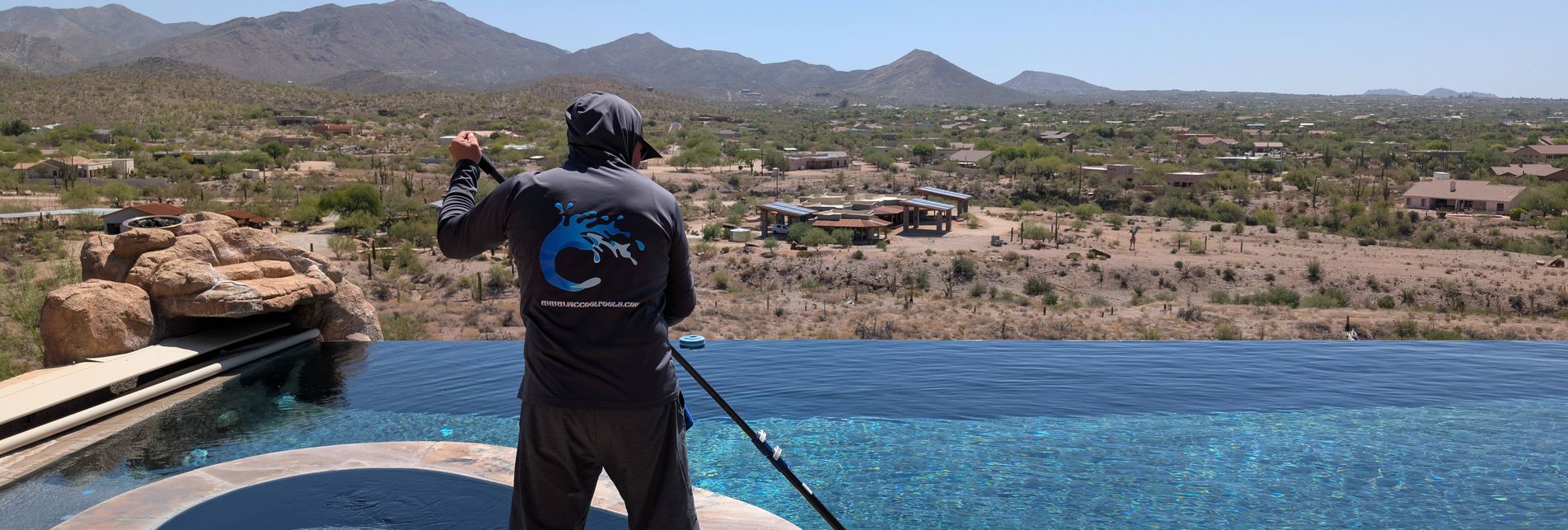


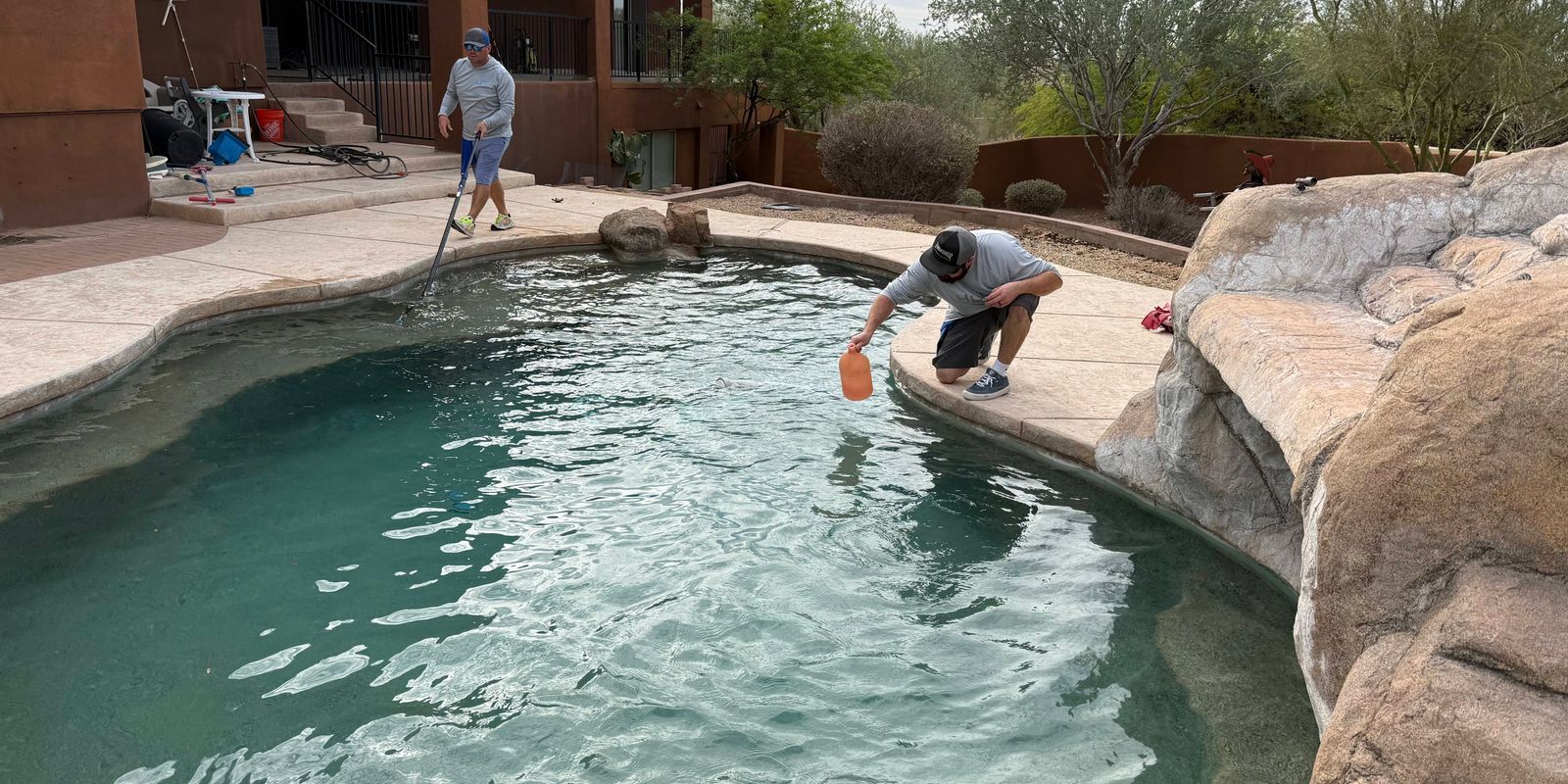

Arizona Summer Doesn't Just Heat You Up — It Heats Your Pool Chemistry
If you've lived through an Arizona summer, you know the drill: triple-digit temperatures from June through September, relentless sun, and pool water that feels more like a hot tub by mid-afternoon. But what most homeowners don't realize is that those extreme conditions are silently waging war on your water chemistry every single day.
The same heat that makes your pool the most popular spot in the neighborhood also burns through chlorine faster, pushes your pH upward, and creates the perfect breeding ground for algae. A pool that looked crystal clear on Monday can turn hazy by Wednesday and green by Friday — not because you did anything wrong, but because Arizona summer chemistry plays by different rules than the rest of the country.
Here's how to stay ahead of it.
Why Heat Destroys Chlorine (And What to Do About It)
Chlorine is the frontline defense in your pool water. It kills bacteria, neutralizes contaminants, and prevents algae from taking hold. But chlorine has a weakness: ultraviolet light and heat break it down rapidly.
In a typical 80°F climate, free chlorine degrades at a manageable rate. In Arizona's 110–115°F summers, with water temperatures regularly hitting 90°F or higher and 14+ hours of intense UV exposure, chlorine can lose 50% or more of its effectiveness in a single day without proper stabilization.
The Role of Cyanuric Acid (CYA)
Cyanuric acid — often called stabilizer or conditioner — acts as sunscreen for your chlorine. It bonds with free chlorine molecules and shields them from UV degradation. In Arizona summers, maintaining proper CYA levels isn't optional; it's survival.
Target CYA range for Arizona summer: 50–80 ppm
Here's the catch: CYA doesn't evaporate or break down easily. It accumulates over time, especially if you use stabilized chlorine tablets (trichlor). Once CYA climbs above 80–100 ppm, it starts locking up your chlorine so tightly that the chlorine can't actually sanitize effectively. You'll test positive for free chlorine, but the water won't be clean. This is called chlorine lock, and it's one of the most common summer problems we see in Phoenix pools.
The fix: If your CYA is above 100 ppm, the only reliable solution is a partial drain and refill. There's no chemical that removes CYA. We recommend draining 1/3 to 1/2 of the pool water and refilling with fresh water to dilute it back into range. (Always drain responsibly — never onto the street, and be mindful of local water restrictions.)
Chlorine Demand in Summer
During peak summer, your pool needs significantly more chlorine than in cooler months. A pool that stays clear on 2–3 ppm of free chlorine in November might need 4–6 ppm in July (assuming CYA is in the 50–80 range).
If you use a tablet feeder or floater, you may need to increase the number of tablets or adjust the feeder flow rate. If your service tech visits once a week, they should be adding enough liquid chlorine to carry the pool through the hottest days between visits.
Pro tip: Liquid chlorine (sodium hypochlorite) doesn't add CYA, making it the preferred sanitizer for Arizona pools that already have adequate stabilizer levels. Tablets are convenient, but they slowly raise CYA all summer long.
pH: The Silent Drifter
pH measures how acidic or basic your pool water is, and in Arizona, it has one direction it loves to go: up.
Several factors push pH higher in summer:
- Heat accelerates CO2 off-gassing. Carbon dioxide dissolved in water acts as a mild acid. When water heats up, CO2 escapes into the air, and pH rises.
- Aeration from water features and returns. Waterfalls, fountains, spillover spas, and even strong return jets introduce air into the water, which also drives off CO2.
- Liquid chlorine has a high pH. Sodium hypochlorite has a pH around 12.5–13. Every time chlorine is added, pH gets a temporary bump.
In a typical Arizona summer, pH can drift from 7.4 to 7.8+ within a few days. Left unchecked, high pH reduces chlorine's sanitizing power (chlorine is dramatically less effective above 7.8), causes calcium to precipitate out of solution and scale your tile and equipment, and makes the water feel uncomfortable on skin and eyes.
Muriatic Acid Is Your Best Friend
The standard correction for high pH is muriatic acid (hydrochloric acid). In Arizona summer, most pools need acid added at every weekly service visit — sometimes more.
Target pH: 7.2–7.6 (we aim for 7.4)
A typical residential pool might need 1–2 quarts of muriatic acid per week in summer to keep pH in range. Pools with water features or spillover spas may need even more.
Safety note: Always add acid to water, never water to acid. Pour it slowly along the pool's edge or near a return jet with the pump running. Never mix muriatic acid with chlorine — the fumes are toxic.
Total Alkalinity: The pH Buffer
Total alkalinity (TA) works as a buffer for pH — it resists rapid pH changes and keeps your chemistry more stable. But there's a balancing act in Arizona.
Target TA: 60–80 ppm (lower than the 80–120 ppm you'll see in most pool chemistry guides)
Why lower? Arizona's naturally hard water and high calcium levels mean that running TA at 100+ ppm virtually guarantees scaling. Lower alkalinity gives you a bit more room before calcium starts depositing on tile, plaster, and equipment. The trade-off is that pH will fluctuate more, but since you're already adding acid weekly in summer, that's manageable.
If TA gets too high, muriatic acid will bring it down (acid lowers both pH and TA). If it drops too low, sodium bicarbonate (baking soda) brings it up without significantly affecting pH.
Calcium Hardness: Arizona's Permanent Guest
Phoenix-area tap water comes out of the faucet at 250–400+ ppm calcium hardness, depending on your water source. The recommended range for pool water is 200–400 ppm, which means Arizona pools are often at or above target before you even add anything.
Target calcium hardness: 200–400 ppm
High calcium combined with high pH, high TA, and high water temperature creates the perfect recipe for scale formation — that white, crusty buildup on your waterline tile, inside your plumbing, and on your heat exchanger and salt cell (if applicable).
In summer, keeping pH and TA in check is the most effective way to prevent calcium scaling, even if your calcium hardness number is high. The chemistry math (measured by the Langelier Saturation Index) shows that controlling pH and TA matters more than trying to lower calcium, which would require constant draining.
Phosphates: Algae Fuel
Phosphates are nutrients that feed algae. They enter your pool from dust, dirt, fertilizer runoff, decaying leaves, and even the tap water itself. Arizona dust storms (haboobs) can dump massive amounts of phosphate-laden dust into your pool overnight.
While phosphates don't directly harm your water chemistry, they make it significantly easier for algae to take hold — especially when chlorine levels dip during a hot week.
What to do:
- Test phosphate levels monthly in summer
- If levels exceed 500 ppb, use a phosphate remover
- Keep the pool clean after dust storms — skim, vacuum, and brush promptly
- Maintain strong chlorine levels as your primary defense
Phosphate removers work, but they're not a substitute for proper chlorine levels. Think of it as removing the food supply while chlorine does the actual killing.
The Summer Chemistry Routine
Here's what a solid summer maintenance routine looks like for an Arizona pool:
Weekly (What Your Pool Service Should Be Doing)
- Test and adjust free chlorine — maintain 4–6 ppm (higher than winter)
- Test and adjust pH — add muriatic acid to keep it at 7.2–7.6
- Brush walls and tile — prevents algae from getting a foothold
- Skim and vacuum — remove organic debris before it decomposes
- Clean skimmer and pump baskets — ensure proper flow
- Inspect equipment — check pump pressure, filter PSI, salt cell (if applicable)
Monthly
- Test CYA — keep at 50–80 ppm; partial drain if over 100
- Test calcium hardness — monitor but focus on pH/TA control
- Test phosphates — treat if above 500 ppb
- Check total alkalinity — maintain 60–80 ppm
- Inspect salt cell (if applicable) — clean calcium buildup
After Every Dust Storm
- Run the pump for at least 8 hours continuously
- Skim all surface debris
- Brush the entire pool
- Shock with extra chlorine if the pool looks hazy
- Clean the skimmer basket (it will be full)
- Check and clean the filter if pressure rises 8+ PSI above clean baseline
When Chemistry Gets Away From You
Even with the best routine, Arizona summer can overwhelm pool chemistry. Here are the warning signs that your water needs professional attention:
- Cloudy water that won't clear despite normal chlorine readings → possible CYA lock or filtration problem
- Green tint or visible algae → chlorine demand has exceeded your current dosing
- White flakes or scaling on tile → calcium precipitation from high pH/TA
- Burning eyes or skin irritation → pH is out of range (usually too high)
- Chlorine smell (yes, really) → paradoxically, a strong chlorine smell means there's not enough free chlorine; what you're smelling is chloramines (combined chlorine), which means the pool needs to be shocked
The Bottom Line
Arizona summer pool chemistry is harder than most of the country because everything works against you: the heat eats your chlorine, the sun amplifies the damage, the hard water wants to scale everything, and dust storms dump algae fuel into your pool overnight. But it's completely manageable with the right knowledge and a consistent routine.
The homeowners who struggle most are the ones running on a set-it-and-forget-it approach that worked fine in April but falls apart by July. Summer chemistry requires adjusting your expectations — more chlorine, more acid, more attention, more frequent testing.
If you're in the Phoenix area and want to stop fighting your pool chemistry every week, give McCool's Pools a call. We service pools across the Valley and know exactly what Arizona water needs — because we deal with it every single day.


 (623) 323-9044
