 Click To Email
  (623) 323-9044
  Opening hours: Mon - Friday, 6:00am to 7:00pm






Nobody Wants to Swim in a Cloudy Pool
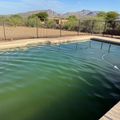
You walk outside, ready to cool off after another 100-degree Arizona day, and your pool looks like someone poured milk into it. Maybe it's a slight haze. Maybe you can't see the bottom. Either way, something's wrong — and ignoring it won't make it go away.
Cloudy pool water is the single most common complaint we hear from Arizona homeowners. The good news? It's almost always fixable once you identify the cause. The bad news? In our desert climate, there are more things working against your water clarity than in most other states.
Here's what's actually happening, why Arizona makes it worse, and exactly how to fix it.
The Five Main Causes of Cloudy Pool Water
1. Poor Filtration or Circulation
This is the number one cause — and the one most people overlook. Your filter is your pool's kidneys. If it's not running long enough, if the media is worn out, or if your pump isn't circulating water effectively, particles stay suspended instead of getting trapped.
Arizona-specific factor: During summer, algae and bacteria grow faster in warm water. A filter run time that worked fine in January won't cut it in July. We see this constantly — homeowners kept their pump on a winter schedule and wonder why the water went cloudy in May.
What to check:
- Run time: Your pump should run a minimum of 8 hours per day in summer, and up to 12 hours during peak heat. Variable-speed pump owners should ensure adequate flow rate, not just runtime.
- Filter pressure: Check your gauge. If it's 8-10 PSI above your clean baseline, it's time to clean the filter. A dirty filter doesn't filter — it just restricts flow.
- Filter media age: Sand lasts 5-7 years. Cartridges last 1-2 years (less in Arizona due to calcium and debris). DE grids should be inspected annually. If you can't remember when you last replaced your media, it's probably overdue.
- Return jets: Put your hand in front of them. If the flow feels weak, you've got a circulation problem — could be a clogged impeller, suction leak, or undersized pump.
2. Unbalanced Water Chemistry
Chemistry is where most pool owners start troubleshooting, and for good reason. Several imbalances directly cause cloudiness:
High pH (above 7.8): When pH climbs, calcium and other minerals come out of solution and form tiny suspended particles. This is the most common chemistry-related cause of cloudy water. Arizona tap water already tends to run alkaline (pH 7.8-8.4 in most Phoenix-area municipalities), so your pool is constantly fighting an uphill battle.
High alkalinity (above 140 ppm): Total alkalinity acts as a buffer for pH. When it's too high, pH becomes resistant to correction and tends to drift upward. The result? See above — mineral precipitation and cloudiness.
High calcium hardness (above 400 ppm): This is Arizona's specialty. Our tap water averages 250-400+ ppm calcium hardness depending on your water source. Every time you add water — topping off from evaporation, backwashing, splash-out — you're adding more calcium. Over months and years, levels creep into the 600-800+ ppm range. At that point, calcium precipitates out of the water and creates a persistent milky haze that no amount of chlorine will fix.
Low chlorine (below 1.0 ppm free chlorine): Without adequate sanitizer, bacteria and algae begin to bloom. The earliest stage of algae growth isn't green — it's cloudy. By the time you see green, you're already behind.
3. Algae (Early Stage)
Full-blown algae is obvious — your water turns green, and everyone panics. But algae starts subtle. The very first sign is often a slight cloudiness or a slippery feel on the walls and steps. If your chlorine is low and your water's been hazy for more than a day or two, there's a good chance microscopic algae is the culprit.
Arizona-specific factor: Water temperatures above 85°F (which we hit by late May and sustain through October) create ideal conditions for algae growth. Combined with intense UV that burns off chlorine faster, Arizona pools are in a constant battle against algae during the warm months.
4. Environmental Contaminants
Arizona's desert environment throws unique challenges at your pool:
- Dust storms (haboobs): A single monsoon-season dust storm can dump pounds of fine desert silt into your pool overnight. This silt is incredibly fine — too fine for some filter media to catch efficiently — and creates that brownish-gray cloudiness.
- Pollen: Spring in the desert means palo verde, mesquite, and citrus trees releasing massive amounts of pollen. This creates a yellowish film and persistent haziness.
- Sunscreen and body oils: With Arizona's outdoor lifestyle, pools get heavy bather loads. Sunscreen, lotions, sweat, and body oils accumulate and overwhelm the sanitizer, creating a dull, hazy appearance.
- Construction dust and neighborhood debris: New construction nearby? That fine concrete and dryite dust travels farther than you think.
5. High Total Dissolved Solids (TDS)
Every chemical you add, every bit of dust that blows in, every drop of sweat — it all adds to your TDS. In Arizona, TDS climbs faster than almost anywhere else because:
- We top off water constantly (evaporation can exceed an inch per week in summer)
- Our fill water already has high mineral content
- We add chemicals more frequently due to intense UV and heat
When TDS exceeds 2,500-3,000 ppm, water loses its ability to hold chemicals in solution effectively. You'll notice the water looks dull even when chemistry tests fine. At that point, a partial or full drain is the only real fix.
How to Fix Cloudy Pool Water: Step by Step
Don't just dump clarifier in and hope. Follow this diagnostic approach:
Step 1: Test Your Water Thoroughly
Grab a good test kit (not just strips — get a Taylor K-2006 or take a sample to a pool store) and check:
- Free chlorine
- pH
- Total alkalinity
- Calcium hardness
- CYA (cyanuric acid/stabilizer)
If you only test chlorine and pH, you're missing half the picture.
Step 2: Fix Chemistry First
If pH is high: Add muriatic acid. In Arizona, you'll use more acid than the national average — it's just part of desert pool ownership. Target pH 7.4-7.6.
If alkalinity is high: Same fix — muriatic acid lowers both, but affects alkalinity more when added in a concentrated pour with the pump off (a technique called "pooling" or "slug dosing"). Target 80-120 ppm.
If chlorine is low: Shock the pool. Use liquid chlorine (sodium hypochlorite) rather than granular — it dissolves instantly and doesn't add calcium or CYA. For a standard 15,000-gallon Arizona pool, 1 gallon of 12.5% liquid chlorine raises free chlorine by about 8 ppm.
If calcium is extremely high (600+ ppm): You likely need a partial drain and refill. No chemical will remove calcium from water. Some pool owners use reverse osmosis water recycling services, which can be worth it if your pool has fresh plaster or tile you don't want to drain around.
Step 3: Clean and Verify Your Filter
After correcting chemistry, make sure your filter can actually do its job:
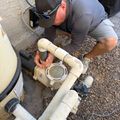
- Cartridge filters: Pull the cartridges, hose them down thoroughly, and inspect for tears or deterioration. Soak overnight in a filter cleaning solution if they're heavily scaled (common in Arizona).
- Sand filters: Backwash until the sight glass runs clear, then rinse. If you haven't changed the sand in 5+ years, it may be channeling and not filtering effectively.
- DE filters: Backwash and recharge with fresh DE powder. Inspect grids annually for tears.
Step 4: Run the Pump Continuously
Once chemistry is corrected and the filter is clean, run the pump 24/7 until the water clears. This is not the time for energy savings — you need maximum filtration turnover. Most pools will clear within 24-72 hours with proper chemistry and continuous filtration.
Step 5: Use Clarifier as a Tool, Not a Crutch
Pool clarifier (a polymer coagulant) groups tiny particles into larger clumps that your filter can catch. It's useful after dust storms or when fine particles won't clear on their own. But clarifier doesn't fix the underlying problem — it just helps your filter finish the job faster.
Pro tip: Don't overdose clarifier. More is not better. Too much clarifier actually reverses the effect and makes water cloudier. Follow the label exactly.
When Cloudy Water Means Something Bigger
Sometimes cloudiness is a symptom of a larger issue:
- Recurring cloudiness every week usually points to inadequate filtration (undersized pump, worn media, not enough run time).
- Cloudiness that returns within hours of clearing suggests a circulation dead spot — water isn't moving through part of the pool, creating a pocket where particles accumulate.
- Cloudiness plus a strong chlorine smell means chloramines (combined chlorine) are high. That "chlorine smell" is actually a sign of not enough free chlorine, not too much. Breakpoint chlorination (superchlorination) is needed.
- Persistent milky haze despite perfect chemistry in an older pool may indicate high TDS or calcium saturation. Time for a drain.
Prevention: Keeping Arizona Pool Water Crystal Clear
The best fix is prevention. Here's what works in our climate:
- Run your pump long enough. 8 hours minimum year-round, 10-12 hours in summer. Variable-speed pumps make this affordable.
- Test weekly. At minimum: chlorine, pH, and alkalinity. Monthly: calcium hardness and CYA.
- Add acid regularly. Arizona pools need muriatic acid almost weekly in summer to keep pH in check. Don't wait until it's at 8.0.
- Maintain your filter on schedule. Clean cartridges monthly, backwash as needed, and replace media on time.
- Skim and brush regularly. Physical removal of debris reduces the load on your filter and chemicals.
- Monitor calcium hardness. If it's creeping above 500 ppm, start planning a partial drain before it becomes urgent.
- Keep CYA in check (30-50 ppm). High CYA locks up chlorine and reduces its effectiveness, which leads to algae, which leads to cloudiness. Read our full CYA guide for more on this.
When to Call a Professional
If you've worked through the steps above and your water still won't clear after 72 hours of continuous filtration with balanced chemistry, something else is going on. It could be a plumbing issue, a failing pump impeller, filter bypass, or a water chemistry problem that needs professional-grade testing (phosphates, metals, etc.).
McCool's Pools offers free water testing and honest diagnosis. We'd rather tell you exactly what's wrong and let you fix it yourself than sell you a service you don't need. And if you do need help, we're here — serving the Phoenix metro area with transparent pricing and no contracts.
Got a cloudy pool right now? Contact us or give us a call. We'll get you swimming again.

 (623) 323-9044
