 Click To Email
  (623) 323-9044
  Opening hours: Mon - Friday, 6:00am to 7:00pm






If Your Pool Keeps "Disappearing Water," Start With the Obvious First
Arizona pool owners notice water loss faster than homeowners in milder climates. That is partly because the heat is brutal, partly because dust and wind are constant, and partly because most pools here get used hard. A busy backyard pool can lose water for perfectly normal reasons. It can also lose water because something is wrong.
The hard part is that those two situations can look identical from the patio. Before you start replacing parts or chasing a leak that may not exist, it helps to understand the three most common causes of water loss:
- Evaporation
- Splash-out and carry-out
- A real leak
Each one leaves a different trail. If you know what to look for, you can usually narrow it down pretty quickly.
Evaporation Is Real, and Arizona Makes It Worse
Evaporation is the water leaving the pool and going into the air. In Arizona, that process never really stops. Hot air pulls moisture off the surface, dry wind speeds it up, and intense sun heats the water enough to make the loss even more noticeable.
The bigger the surface exposure, the more water you lose. A wide shallow pool or a pool with a lot of sun exposure will usually lose more water than a smaller, shaded one. Add in water features, a spa spillway, or a lot of wind, and the loss can feel dramatic.
Evaporation is not a defect. It is just the environment doing what it does here.
What makes it expensive is that every gallon you add back changes your chemistry. New water brings in minerals, especially in Arizona, where tap water is often hard.
Splash-Out Can Look Like a Leak, but It Is Really Usage
Splash-out happens when swimmers, dogs, kids, or strong water features physically throw water out of the pool. Carry-out is the water people drag out on bodies, toys, floats, and towels.
This is the easiest kind of water loss to underestimate because it usually happens in bursts. You might not notice much during the week, then have a family party, some heavy cannonballs, and a running waterfall, and suddenly the water line looks low.
If your pool loses more water after weekends, pool parties, or hot afternoons with a lot of activity, splash-out is probably part of the answer.
You can reduce it by lowering unnecessary water features when the pool is busy, keeping deck traffic from tracking water out, and making sure return jets are not blasting straight up or across the surface.
Splash-out does not mean your pool is leaking. It means your pool is getting used.
The Quick Bucket Test Is Still the Best First Check
If you want a simple way to compare pool loss against normal evaporation, do a bucket test.
Use a plain bucket on a pool step or shallow ledge, fill it so the water level inside is close to the pool level, mark both lines, and check it again after 24 hours. If the pool drops about the same amount as the bucket, you are probably looking at evaporation. If it drops noticeably more, water is leaving somewhere else.
Watch the Waterline, Not Just the Total Drop
The pattern matters as much as the amount. Evaporation tends to be slow and even. Splash-out usually shows up after active use and then stabilizes. A real leak often creates a repeatable stopping point, which can point to the skimmer, a return line, a light niche, or a plumbing issue below grade.
The Usual Leak Suspects in Arizona Pools
Arizona heat does not create leaks, but it does make weak spots show up faster. When a system is under stress, the old problem finally becomes obvious.
The most common leak areas are:
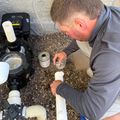
- Pump lid O-rings and plumbing unions
- Filter tanks and multiport valves
- Heater connections
- Return fittings and light niches
- Skimmers and skimmer throats
- Cracked fittings around the spa or water feature plumbing
- Underground suction or return lines
Some leaks are visible. You will see wet soil, dripping equipment, or air getting pulled into the system. Others are sneaky and only show up as a pool that seems to "drink" water.
Autofill Can Hide the Real Problem
A lot of Arizona pools have an autofill, and it is easy to assume that means water loss does not matter. That is a mistake.
An autofill is helpful because it keeps the pool from getting dangerously low. But it also masks the rate of loss. A homeowner may not notice a leak for weeks because the autofill keeps quietly replacing the water.
That means your water bill may be the first warning sign, and your chemistry may drift because fresh water keeps entering the pool.
If the pool has an autofill, still check the water level line regularly. If the autofill seems to be running constantly, that is not normal "maintenance." It is a problem trying to stay hidden.
Hard Water Makes Refill Costs Worse Than They Look
This is the part a lot of homeowners miss. Every gallon you replace brings in more calcium and more minerals. Over time, that can create scale on tile, shorten the life of salt cells and heaters, and make your chemistry harder to keep in range. Even if your water loss is just evaporation, a pool that constantly needs top-offs should be treated as a maintenance issue, not just a utility bill issue.
What You Can Check Yourself Before Calling for Help
There is a lot a homeowner can safely do before bringing in a leak specialist. Start with the water level against the skimmer opening, look for air bubbles in the pump basket or return lines, inspect the equipment pad for moisture or drips, and run the bucket test. If the water loss seems tied to the pump running, that points more toward plumbing or equipment than evaporation.
If the pool loses water even with the pump off, look harder at the shell, fittings, skimmer, or a crack somewhere in the vessel.
When a Leak Is Worth Calling in Right Away
Some problems are worth handling fast because waiting only adds cost.
Call a professional sooner if the pool loses more than a normal evaporation amount every day, the autofill is running constantly, the equipment pad stays wet, you see air in the system, or you suspect an underground line leak or structural crack.
Leaks do not usually fix themselves. They get worse, and they often take nearby parts with them.
The Best Arizona Strategy: Catch the Pattern Early
The simplest way to stay ahead of water loss is to stop thinking of it as a once-a-month problem. Check the level regularly, watch for changes after windy days or heavy heat, and keep an eye on how often the autofill kicks on. Arizona pools can absolutely lose water without anything being broken, but if the pool starts needing constant refills, the system is telling you something.





 (623) 323-9044
