 Click To Email
  (623) 323-9044
  Opening hours: Mon - Friday, 6:00am to 7:00pm






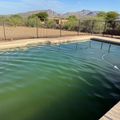
Arizona Pools Do Not Fail All at Once
Most pool problems do not show up as disasters. They start as little changes that are easy to ignore. A waterline that looks dirtier than usual. A pump that sounds a little different. A chlorine reading that is off. A filter that seems to need cleaning too often. In Arizona, those small changes move faster because the environment works against the pool.
Heat burns through sanitizer. Dust settles into the water and loads up the filter. Hard water leaves calcium behind. Monsoon storms dump debris and dilute chemistry. Add in long swim seasons and strong sun, and you get a pool that needs steady attention instead of occasional rescue work.
That is why a monthly reset matters. You do not need to turn pool care into a full-time project. You just need a short routine that catches the stuff most homeowners miss until it is expensive.
Start With the Water Level and the Waterline
Before you touch chemicals or equipment, look at the pool itself.
Check the water level first. In Arizona, evaporation can pull the level down faster than people expect, especially in hot, windy weeks. If the level gets too low, the pump can start pulling air and the system loses efficiency. If it is too high, skimmers stop working as well and debris floats past instead of getting captured.
Then look at the waterline tile or coping. If the line is starting to crust over, that is usually your first sign of mineral buildup. It is easier to clean a little scale once a month than to chip away at a thick ring later.
If you only do one visual check each month, make it this one.
Test the Water Before You Guess
Arizona owners often know when the water “feels off,” but guessing is expensive. A monthly test gives you a real baseline.
At minimum, check:
- Free chlorine
- pH
- Total alkalinity
- Calcium hardness
- Cyanuric acid if your pool uses stabilized chlorine
Why these matter in Arizona:
- Free chlorine gets used up quickly in heat and sun.
- pH tends to drift upward and can reduce sanitizer efficiency.
- Alkalinity helps keep pH from swinging around.
- Calcium hardness matters because hard water leaves scale on tile, heaters, and salt cells.
- Cyanuric acid can creep up if tablets are used heavily, which can make chlorine less effective even when the reading looks fine.
The point is to catch drift before you start buying chemicals reactively every week.
Clear the Debris Before It Becomes a Chemistry Problem
Arizona dust looks harmless until it collects enough to create cloudy water, clogged baskets, and extra chlorine demand.
Once a month, do the simple stuff:
- Empty skimmer baskets
- Empty the pump basket
- Skim visible debris off the surface
- Brush steps, corners, benches, and the waterline
- Check around returns and dead spots for settled dust
If you brush before debris breaks down, you help the filter catch it instead of letting it sit on the floor and feed algae. That matters even more after windy weeks, backyard landscaping work, or a storm that dumped fine dust into the pool.
Clean water needs less corrective chemical work than water that is constantly loading up on organic debris.
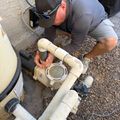
Listen to the Equipment While It Is Running
You do not have to be a technician to notice when the system sounds different.
Stand near the pump and listen for:
- A louder-than-normal motor
- Grinding, whining, or rattling
- Air burping through the returns
- A pump basket that is half air
- Water flow that seems weaker than last month
These are early warnings, not just background noise. In Arizona, a pump that is losing prime or running against a dirty filter wastes electricity and shortens equipment life. A noisy pump is often trying to tell you something before it quits entirely.
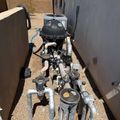
If the equipment pad is hot, wet, or smells burned, get it checked.
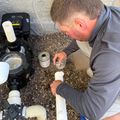
Check the Filter Pressure and Clean It on Time
The pressure gauge is the fastest way to see whether your circulation system is healthy.
If the pressure is clearly above your normal clean baseline, the filter is probably loaded with debris or scale. If the pressure is unusually low, you may have a suction-side issue, an air leak, or a clogged basket before the filter.
Arizona pools tend to need more frequent filter attention because dust, pollen, sunscreen, and hard-water residue all work together to slow things down. That is normal. What is not normal is ignoring a filter until the pool turns cloudy and the pump starts straining.
Do not wait for a problem to be obvious. Keep the filter on a schedule that matches your actual pool conditions, not the label on the tank.
Watch for Arizona-Specific Wear
Arizona has a few built-in pool stresses that show up again and again:
Heat: Hot water burns through sanitizer faster and makes algae recovery harder.
Hard water: Every top-off adds minerals back into the pool, which is why scale can build so quietly.
Dust: Fine debris overwhelms baskets and filters faster than most out-of-state owners expect.
Monsoons: Rain and wind can both wreck chemistry, even if the pool looks fine at first glance.
Sun exposure: UV exposure fades equipment labels, dries out seals, and makes plastics age faster.
If your pool has been topping off more often than usual, if the tile line is whitening, or if the water is suddenly harder to keep balanced, those are clues. Arizona pools usually do not need more random product. They need the underlying cause addressed.
Use the Monthly Reset to Save Energy Too
Good maintenance is also energy efficiency.
When the water is clean, the filter is clear, and circulation is smooth, the pump does not have to work as hard. That can mean:
- Shorter run times that still keep the pool healthy
- Lower-speed operation on variable-speed pumps
- Less pressure on the system from clogged baskets or dirty filters
- Fewer emergency run cycles to fix avoidable water-quality issues
If your pool is constantly cloudy or out of balance, you usually end up paying twice: once in extra chemicals and again in extra electricity. A monthly reset helps stop that cycle.
A Simple Monthly Arizona Pool Reset
If you want the short version, use this checklist once a month:
- Check the water level and waterline.
- Test chlorine, pH, alkalinity, calcium, and stabilizer.
- Empty baskets and skim debris.
- Brush the pool before dust settles in.
- Listen to the pump and watch the flow.
- Read the filter pressure and clean the filter if needed.
- Look for leaks, scale, corrosion, or anything that changed since last month.
That is enough to catch most of the expensive problems early.
What You Should Handle Yourself
Homeowners can usually handle skimming, brushing, water testing, checking the level, and a visual inspection of the pad. What you should not ignore is repeated air in the system, a pump that is overheating or getting louder, a breaker that trips more than once, or water that stays cloudy after you have done the basics.
DIY is smart when it prevents problems. It stops being smart when you keep treating the same symptom and never find the cause.
Safety Still Comes First
Pool care should never turn into a risky repair.
Be careful around:
- Electrical equipment near water
- Chemicals stored together
- Pressurized filters that have not been safely relieved
- Slippery decks and wet equipment pads
- Anything that smells burned or looks overheated
If something seems electrical, plumbing-related, or pressure-related and you are not sure what you are looking at, call someone who does this.
The Bottom Line
Arizona pool care works best when it is boring and consistent. A monthly reset keeps the water stable, the equipment quieter, and the repairs smaller. It helps you spot hard-water scale before it becomes a cleanup job, dust before it becomes cloudy water, and circulation issues before they become equipment failures.
That is the real goal: not perfect water every day, but a pool that stays predictable in a climate that is anything but predictable.
If you want help tightening up your pool care routine or tracking down a stubborn problem, contact McCool's Pools. We can help you find the weak spot before it turns into a bigger bill.









 (623) 323-9044
